
Critical Reflectance Maximisation in Glass Beads (R1–R5 Levels)
Glass bead drop-on rates that increase night-time driving safety by 70%, and our retroreflective performance test results.
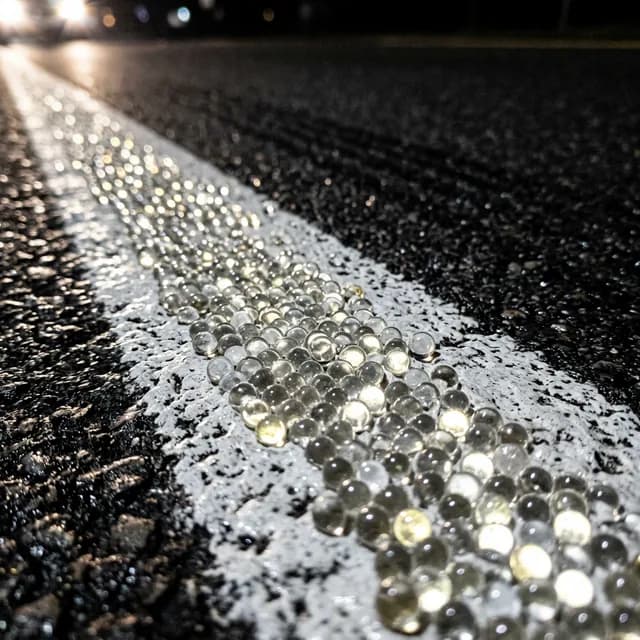
What keeps drivers safe at night is not the white paint itself, but the millions of microscopic glass beads embedded in it at the right angle.
The Refractive Index of Light (RI)
While an R3 (150 mcd/lux/m²) night visibility class is targeted on a standard motorway, special glass beads with a high refractive index (RI > 1.9) make it possible to reach R5 (300+ mcd/lux/m²) on dangerous bends. Light from the vehicle's headlamps enters the bead, strikes the titanium dioxide (white pigment) layer behind it and returns to the driver's eye.
The 60% / 40% Rule: Optimum Embedment Theory
For glass beads to reflect, the paint film thickness and bead diameter must match perfectly. In an ideal application, 60% of the bead should be embedded in the paint, while the remaining 40% at the top stays on the surface (in the air).
If the bead is fully embedded in the paint, it cannot reflect (it goes blind). If more than 50% of it stays outside, it is thrown off the road at the first tyre impact.
With the synchronised double-gun technology used in Renga Plus systems, glass beads are injected into the heart of the paint at exactly 2 bar pressure in the millisecond window in which the paint reaches the asphalt surface. Wind losses are reduced to zero and maximum retroreflectivity is achieved.