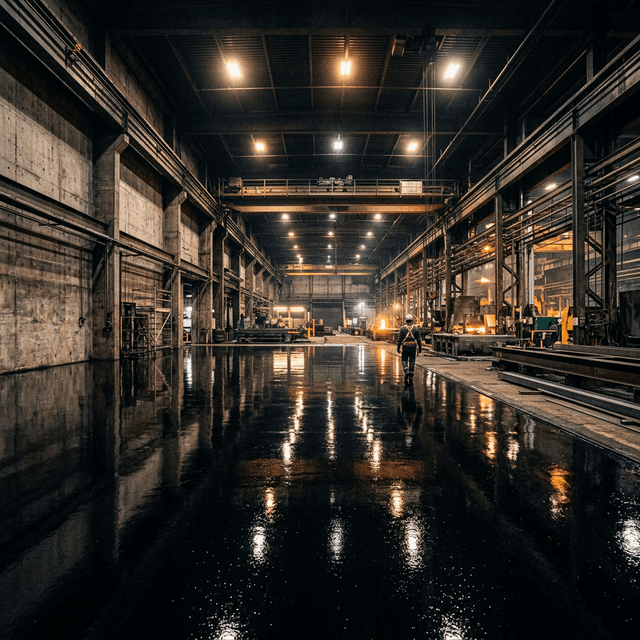
Heavy load-resistant, non-dusting floor engineering solutions for factories, warehouses, and parking lots.
The heart of industrial facilities is the floor. Heavy tonnage forklift traffic, chemical spills, mechanical impacts, and constant vibration... Standard concrete dusts and cracks over time against these loads. Renga Plus Industrial Floor Systems not only protect your floor but also increase your operational efficiency.
Epoxy: Hardness and Hygiene
Epoxy coatings integrate with concrete with their thermoset polymer structure and create a monolithic (seamless) surface.
- **Strength:** Increases the compressive strength of concrete by 3 times.
- **Hygiene:** Does not harbor bacteria thanks to its non-porous structure, suitable for GMP standards for pharmaceutical and food factories.
- **Aesthetics:** Non-slip can be achieved with "Orange Peel" texture or a glass-smooth floor with "Self-Leveling".
Polyurethane: Flexibility and UV Resistance
Unlike epoxy, polyurethane systems are flexible (elastomeric). Thus, they do not crack against thermal shocks (sudden temperature changes - cold storage) and building movements. Also, since it is resistant to UV rays, it does not change color in open parking lots and terraces.
Application Protocol
1. **Shot Blasting:** The concrete surface is roughened by the blasting method.
2. **Moisture Barrier:** Special primer is applied against rising damp.
3. **Intermediate Coat and Sanding:** Layer thickness is created.
4. **Top Coat:** Final coat is applied in the desired color (RAL K7).